
Is Kidney Transplant Better Than Dialysis?
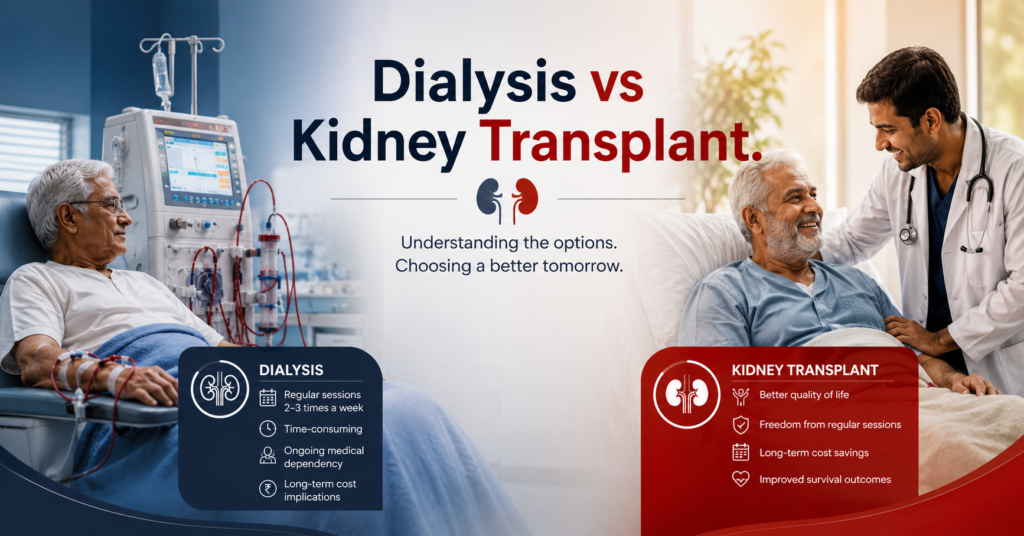
For medically eligible patients, kidney transplant is usually considered better than long-term dialysis because it can offer better quality of life, more freedom, and better long-term survival. Dialysis is still life-saving, especially for patients waiting for a donor or those who are not fit for transplant.
The National Kidney Foundation describes transplant as the preferred treatment option for kidney failure because it can free patients from dialysis, improve life expectancy, and improve quality of life. However, not every patient qualifies for transplant. Doctors must check age, heart health, infection status, cancer history, donor availability, and ability to take lifelong medicines
What Happens in Kidney Failure?
Kidneys clean waste, balance fluid, control blood pressure, support red blood cell production, and maintain important minerals in the body.
When kidneys stop working properly
When kidneys fail, waste and extra fluid build up in the blood. This can affect energy levels, breathing, blood pressure, blood count, and overall health.
At this stage, patients usually need renal replacement therapy. The two main options are dialysis and kidney transplant.
This can lead to:
Replaces some kidney functions from outside the body.
Replaces the failed kidney with a healthy donor kidney.
What Is Dialysis?
Dialysis is a treatment that removes waste, extra fluid, and toxins from the blood when kidneys can no longer do this properly.
There are two common types:
Hemodialysis
Hemodialysis is usually done in a dialysis center. Blood passes through a dialysis machine, gets cleaned, and returns to the body.
Many patients need it around three times a week. Each session may take several hours.
Peritoneal Dialysis
Peritoneal dialysis uses the lining of the abdomen to clean the blood. It can often be done at home after proper training.
Dialysis can help patients live longer and control symptoms. But it is ongoing. It does not cure kidney failure.
Patients often need strict diet control, fluid limits, regular sessions, and frequent monitoring.
What Is Kidney Transplant?
Kidney transplant is a surgery where a healthy kidney from a living or deceased donor is placed into the patient’s body.
The new kidney takes over the work of filtering blood and removing waste.
The failed kidneys are usually not removed unless they are causing specific problems.
A transplant can come from:
- a living related donor
- a living unrelated donor, where legally allowed and approved
- a deceased donor
After transplant, patients need lifelong anti-rejection medicines. These medicines reduce the chance of the body rejecting the new kidney.
NHS guidance explains that kidney transplant is a major operation, and patients need immunosuppressant medicines after surgery to help prevent rejection.
Dialysis vs Kidney Transplant: Key Differences
| Factor | Dialysis | Kidney Transplant |
|---|---|---|
| Treatment type | Ongoing blood cleaning treatment | Surgery to place a donor kidney |
| Best for | Patients waiting for donor or not fit for surgery | Eligible patients with suitable donor |
| Lifestyle | Fixed treatment schedule | More freedom after recovery |
| Diet and fluid limits | Usually stricter | Usually fewer restrictions |
| Travel flexibility | More difficult | Easier after recovery and doctor clearance |
| Long-term survival | Usually lower than transplant in eligible patients | Usually better in suitable patients |
| Cost pattern | Repeated lifetime cost | Higher upfront cost plus medicines |
| Main risk | Infection, access problems, fatigue, heart strain | Surgery, rejection, infection, medicines |
| Donor needed | No | Yes |
| Follow-up | Continuous dialysis schedule | Lifelong follow-up and medicines |
The simple answer is this: dialysis supports life, while transplant can give a better chance at a more normal life for eligible patients.
But eligibility is the deciding factor.
When Dialysis May Be the Right Option
Dialysis may be the better or only option when the patient is not ready for transplant.
Doctors may continue dialysis when:
When Kidney Transplant May Be the Better Option
Kidney transplant may be better when the patient is medically fit and the transplant team believes surgery can improve survival and quality of life.
Transplant may be considered when:
- the patient has end-stage kidney disease
- dialysis is affecting daily life
- a suitable donor is available
- the patient can tolerate surgery
- heart and lung health are acceptable
- there is no uncontrolled infection
- cancer risk is cleared
- family support is available
- the patient can take lifelong medicines
- follow-up care is possible
A systematic review found that kidney transplantation is linked with lower mortality and improved quality of life compared with chronic dialysis treatment, although individual outcomes vary depending on patient condition and other risk factors.
This is why transplant evaluation should start early. Waiting too long can make the patient weaker.
Lifestyle After Dialysis vs Kidney Transplant
This is one of the biggest differences for patients and families.
Dialysis can control kidney failure, but it comes with routine restrictions.
Patients may need:
After recovery, many transplant patients experience more freedom.
They may have:
But transplant is not “treatment finished.” Patients still need:
Cost Comparison: Dialysis vs Kidney Transplant in India
Cost depends on city, hospital category, patient condition, donor evaluation, complications, ICU stay, medicines, and follow-up.
Dialysis Cost Pattern
Dialysis cost looks smaller per session, but it continues for life unless the patient gets a transplant.
Long-term dialysis expenses may include:
- dialysis sessions
- injections
- medicines
- blood tests
- access surgery
- hospital admissions
- travel to dialysis center
- missed work days
- caregiver time
Kidney Transplant Cost Pattern
Kidney transplant has a higher upfront cost.
Transplant expenses may include:
- donor evaluation
- recipient evaluation
- surgery
- ICU stay
- hospital stay
- blood products
- medicines
- infection care
- rejection monitoring
- follow-up tests
- lifelong immunosuppressants
The cheaper-looking option is not always cheaper long term.
For eligible patients, transplant may reduce the repeated burden of dialysis. But families should ask for a clear estimate that includes surgery, ICU, donor testing, medicines, and follow-up.
Planning treatment in India?
Get expert guidance on hospitals, doctors, cost estimates, and travel support.
Kidney Transplant Eligibility Checklist
A patient may be considered for kidney transplant when most of these points are favorable.
Medical Readiness
Donor and Matching Review
Recovery and Family Support
Doctors also check whether dialysis should continue while transplant preparation is underway.
A transplant decision is not based only on creatinine or dialysis frequency. It depends on the full medical picture.
Risks of Dialysis vs Kidney Transplant
Both treatments have risks. The right choice depends on the patient’s full medical condition, fitness for surgery, donor availability, and long-term care plan.
Dialysis-related risks may include:
Transplant-related risks may include:
This is why the decision should not be emotional or rushed.
Families should ask the transplant team clear questions before deciding between dialysis and kidney transplant.
Kidney Transplant in India for International Patients
India is a common destination for patients exploring kidney transplant because of specialist availability, hospital infrastructure, and comparatively lower treatment costs.
But kidney transplant for international patients needs careful planning.
International patients usually need:
- latest kidney reports
- dialysis history
- donor details
- blood group reports
- HLA and crossmatch testing guidance
- passport copies
- medical visa documents
- relationship proof between donor and recipient
- hospital invitation letter
- cost estimate
- legal and authorization committee clearance
- post-transplant stay plan
- follow-up plan after returning home
For foreign patients, India has strict rules around living donors. NOTTO guidance states that no Indian living donor is permitted to donate to a foreign recipient unless the donor is a near relative, and relationship certification from the embassy or relevant authority may be required.
NOTTO also provides official forms related to living donor transplant approval and hospital authorization processes.
This means paperwork is not a small detail. It can decide whether treatment moves forward or gets delayed.
Dialysis vs Kidney Transplant: Which Is Better?
For most medically eligible patients, kidney transplant is usually the better long-term option.
It may offer:
- better quality of life
- more freedom
- fewer diet restrictions
- better long-term survival
- less dependence on hospital visits
- better ability to return to normal activities
But dialysis remains the right option when transplant is not possible, not safe, or not ready yet.
So the real question is not:
“Which is better for everyone?”
The better question is:
“Which option is safer and better for this patient right now?”
That answer depends on age, reports, dialysis history, donor availability, infection risk, heart health, finances, family support, and legal approval.
How Medical Tourism Support Helps
For kidney failure patients, families often feel overwhelmed. They speak to multiple hospitals, compare cost estimates, worry about donor testing, and struggle with visa documents.
A kidney transplant journey is not only a surgery journey.
It is a planning journey. Families need clear guidance before they travel, during hospital admission, and after the patient returns home.
Medical tourism support helps patients avoid confusion, repeated calls, unclear estimates, and last-minute documentation delays.
Medical tourism support can help with:
Need help planning kidney transplant in India?
Share the patient’s latest reports, dialysis history, and donor details if available. Zinek Healthcare can help you understand the next practical step.

Final Recommendation
Dialysis and kidney transplant both save lives. But they serve different roles.
Dialysis is essential when the patient needs ongoing blood cleaning, is waiting for a donor, or is not fit for surgery.
Kidney transplant is often better for eligible patients because it may offer better survival, better lifestyle, and more independence.
Families should not decide based only on cost or fear.
The best next step is to collect the patient’s latest reports, dialysis history, donor details if available, and get a kidney transplant eligibility review.
If transplant is possible, early planning gives the patient more options.
If dialysis is safer for now, the family can continue dialysis with a clearer plan.
In kidney failure, timing matters.
So does choosing the right medical team.
FAQ
Is kidney transplant better than dialysis?
For medically eligible patients, kidney transplant is usually considered better than long-term dialysis because it may improve quality of life, survival, and freedom from fixed dialysis sessions. But dialysis remains important when transplant is not possible or not yet ready.
Can dialysis patients get kidney transplant?
Yes. Many dialysis patients can be evaluated for kidney transplant. Doctors check overall fitness, heart health, infection status, cancer history, donor suitability, and ability to take lifelong medicines.
How long can a person stay on dialysis?
Some patients remain on dialysis for many years, but outcomes depend on age, health condition, diabetes, heart disease, infection risk, and dialysis quality. A doctor can guide whether transplant evaluation should be considered.
What is the biggest advantage of kidney transplant?
The biggest advantage is better long-term quality of life for suitable patients. Many transplant patients have more freedom, fewer diet restrictions, better energy, and less dependence on dialysis sessions.
What are the risks of kidney transplant?
Kidney transplant risks include surgery complications, infection, rejection, medicine side effects, and lifelong follow-up needs. Patients must take anti-rejection medicines regularly.
Can international patients get kidney transplant in India?
Yes, international patients can explore kidney transplant in India, but they need proper medical reports, donor documents, relationship proof, medical visa documents, hospital approval, and legal clearance where required.
Is kidney transplant cheaper than dialysis?
Kidney transplant has a higher upfront cost, while dialysis has repeated long-term costs. For eligible patients, transplant may reduce the long-term burden of dialysis, but costs vary by hospital, city, complications, and medicines.