
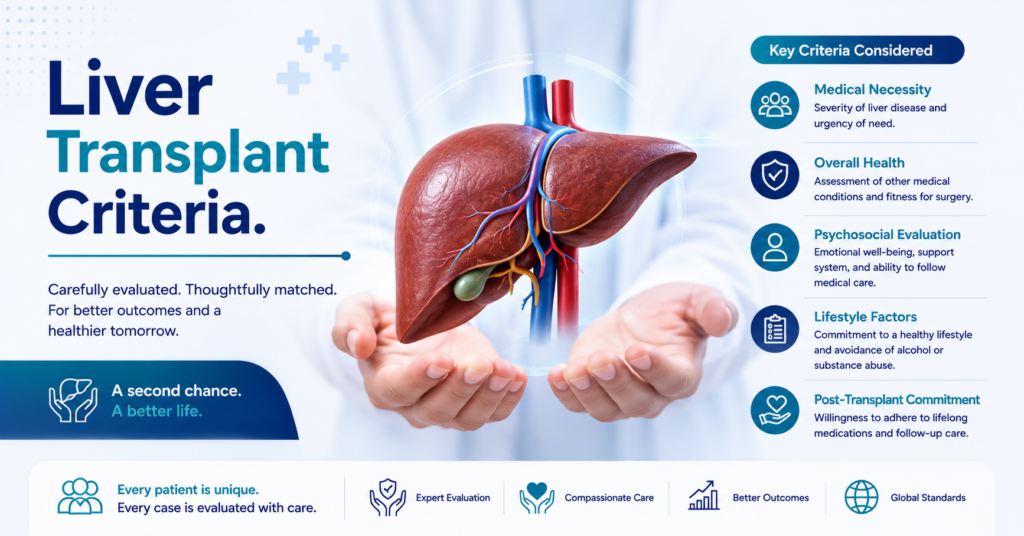
Understanding Liver Transplant Eligibility Before You Make a Decision
Liver transplant criteria help doctors decide whether a patient truly needs a transplant, can safely undergo surgery, and is likely to recover well after the procedure. A patient may qualify if they have end-stage liver disease, acute liver failure, advanced cirrhosis, selected liver cancers, or severe liver damage that no longer improves with medicines.
But liver transplant approval does not depend on one report.
Doctors look at the full picture: liver function, MELD score, heart health, lung health, infection status, cancer stage, kidney function, nutrition, mental readiness, donor availability, and family support.
That is why families often feel confused.
One doctor may say, “The liver is failing.” Another may say, “We need more tests before transplant.” Both can be right.
This guide explains liver transplant eligibility in simple language, especially for Indian and international patients planning treatment in India.
Who Qualifies for a Liver Transplant?
A patient may qualify for liver transplant when the liver is damaged beyond recovery and doctors believe transplant can improve survival and quality of life.
Doctors usually consider liver transplant for:
Liver transplant is often used when chronic liver disease reaches an advanced stage or when a healthy liver suddenly fails because of acute liver failure. Mayo Clinic also notes that the MELD score helps estimate urgency for transplant in adults.
Why Liver Transplant Criteria Matter
Liver transplant is not a routine surgery.
It is a major operation where doctors remove the diseased liver and replace it with a healthy liver from a deceased donor or part of a liver from a living donor.
The surgery can save lives. But it also needs careful planning.
Doctors must answer two questions:
This balance matters. A patient who is too early in disease may not need transplant yet. A patient who is too unstable may need ICU care, infection control, or nutrition support before surgery.
A patient with uncontrolled infection, cancer spread outside the liver, or severe heart disease may not qualify immediately.
Common Conditions That May Lead to Liver Transplant
Doctors may suggest transplant evaluation when liver damage becomes severe, symptoms keep returning, or the patient’s condition can no longer be managed safely with medicines alone.
End-Stage Liver Disease
End-stage liver disease means the liver has lost most of its working capacity. Medicines may reduce symptoms, but they cannot fully restore liver function.
Common causes include:
Patients may develop swelling, jaundice, weakness, fluid in the abdomen, confusion, bleeding, kidney stress, or repeated infections. When these complications keep coming back, transplant evaluation becomes important.
Cirrhosis With Complications
Cirrhosis means long-term scarring of the liver. Some patients live with stable cirrhosis for years. But when complications start, doctors may suggest transplant evaluation.
Common warning signs include:
This is where timing matters. Waiting too long can make surgery riskier.
Acute Liver Failure
Acute liver failure happens quickly. A person may not have known liver disease earlier, but the liver suddenly stops working.
Possible causes include:
This is usually an emergency. Doctors may act fast because the patient can worsen within days.
Liver Cancer
Some patients with liver cancer may qualify for liver transplant if the cancer stays within accepted limits and has not spread outside the liver.
Doctors check:
If cancer has spread too far, transplant may not help. In that case, doctors may suggest other cancer treatments first.
Get an Estimate for Liver Transplant in India
Share basic patient details and available medical reports. Zinek Healthcare can help you understand possible hospital options, cost range, donor document needs, and next steps for liver transplant planning in India.
Share diagnosis reports, MELD score, scans, and donor details if available.
Compare suitable hospitals based on patient condition, location, and budget.
Get support for medical visa, stay planning, airport pickup, and follow-up coordination.
Request Liver Transplant Estimate
Fill the form and Zinek Healthcare will guide you on the next step.
MELD Score and Liver Transplant Priority
The MELD score helps doctors measure how serious liver disease has become. It also helps decide urgency for liver transplant.
What does MELD mean?
MELD stands for Model for End-Stage Liver Disease. It commonly uses blood test values such as bilirubin, creatinine, INR, and sodium in MELD-Na.
These values help doctors understand liver function, kidney stress, and blood clotting ability.
MELD scores usually range from 6 to 40. A higher score means higher urgency and greater short-term risk without transplant.
Simple MELD Score Guide
| MELD Score | What It Usually Means |
|---|---|
| Below 10 | Lower short-term urgency |
| 10–19 | Moderate liver disease severity |
| 20–29 | Higher transplant urgency |
| 30–40 | Very high risk and stronger urgency |
But MELD score is not the only decision point. A patient with a lower MELD score may still need review if they have repeated complications.
A better question is: “Does the full clinical picture show that transplant evaluation should start now?”Liver Transplant Eligibility Checklist
A patient may be considered for liver transplant when most of these points match.
Tests Required Before Liver Transplant
Before approval, doctors usually run a complete transplant evaluation.
Who May Not Be Eligible for Liver Transplant?
Some patients may not qualify immediately. Some may need treatment first and reassessment later.
Living Donor Liver Transplant Criteria
In living donor liver transplant, a healthy person donates part of their liver. The liver can grow back over time in both donor and recipient.
Why living donor transplant matters
This option can reduce waiting time, especially where deceased donor availability is limited.
Living donor evaluation protects both people: the donor and the patient.
A donor may want to help, but doctors still need to confirm safety. No transplant team should take donor safety lightly.
Living donor eligibility usually includes:
Liver Transplant Criteria in India for International Patients
International patients can consider liver transplant in India, but planning must be organized from the start.
Patients from Bangladesh, Nepal, Africa, Mauritius, Thailand, and the Middle East often explore India because of specialist access, hospital infrastructure, and cost advantage compared with many Western countries.
But liver transplant is more complex than routine medical travel.
India-Specific Legal and Approval Process
Liver transplant in India follows medical and legal review systems, especially for living donor transplant.
How Zinek Healthcare Can Help
For liver transplant planning, families need more than a hospital name. They need a clear path.
Support that makes the journey clearer
This support becomes especially useful for international patients.
When the patient is sick, families should not waste time calling multiple hospitals, repeating the same story, and chasing unclear estimates.
A structured process saves time. In liver transplant, that matters.
💬 Chat on WhatsAppZinek Healthcare can help with:
What Families Should Do Next
Liver transplant criteria are not based on one number, one scan, or one symptom. Doctors look at the full patient picture.
A patient may qualify when:
Best next step
Collect reports early and get a transplant eligibility review.
Do not wait until the patient becomes too weak.
FAQ About Liver Transplant Criteria
These answers cover the most common questions families ask before planning liver transplant in India.
Who qualifies for liver transplant?
A patient may qualify for liver transplant if they have end-stage liver disease, acute liver failure, advanced cirrhosis, selected liver cancers, or severe liver-related complications that no longer respond well to medical treatment.
What MELD score is needed for liver transplant?
There is no single MELD score that applies to every patient. Higher MELD scores usually show higher urgency. Doctors use MELD along with symptoms, complications, donor availability, and overall medical fitness.
Who is not eligible for liver transplant?
A patient may not qualify if they have uncontrolled infection, cancer that has spread outside the liver, severe heart or lung disease, active substance misuse, or inability to follow lifelong medicines and follow-up care.
Can international patients get liver transplant in India?
Yes. International patients can consider liver transplant in India if they have proper medical reports, passport and visa documents, donor documents if needed, hospital approval, and legal clearance where applicable.
What tests are required before liver transplant?
Common tests include liver function tests, kidney tests, viral markers, CT or MRI abdomen, cardiac evaluation, lung assessment, infection screening, nutrition review, and psychological evaluation.
Is living donor liver transplant safe?
Living donor liver transplant can be safe when the donor is healthy and passes strict medical, psychological, and legal evaluation. Donor safety remains one of the main priorities in transplant planning.
How long does recovery take after liver transplant?
Initial hospital recovery may take a few weeks, but complete recovery takes longer. Patients need regular follow-ups, blood tests, infection prevention, and lifelong anti-rejection medicines.